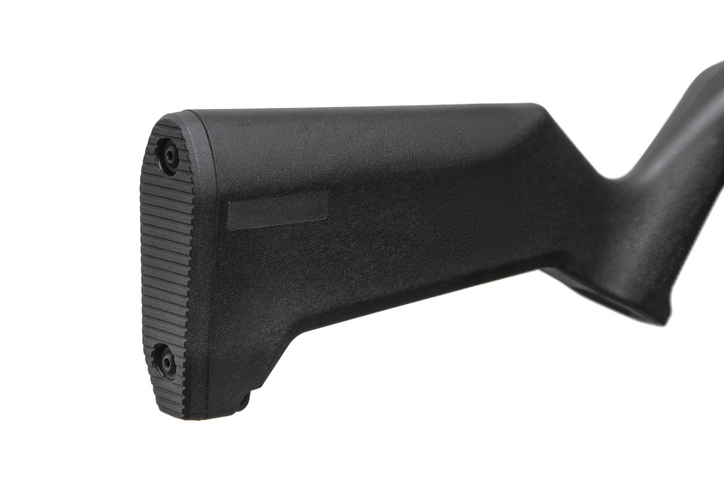
Firearm components operate in a mechanically unforgiving environment. Loads are cyclic, temperatures fluctuate, tolerances are tight, and failure carries consequences well beyond scrap or rework. When plastics are introduced into these systems, material selection relies more on long‑term behavior under real operating conditions than on the strength listed in the material datasheet.
This post focuses on material‑driven considerations engineers evaluate when specifying plastics for firearm components, with an emphasis on performance limits, tradeoffs, and failure risks.
Plastics vs Metal: Material Tradeoffs in Firearm Components
When making material decisions for firearm manufacturing, the choice is often between metal and plastic. Many firearm designs combine plastics and metals to balance weight, strength, and manufacturability. Plastics can reduce mass, damp vibration, and simplify complex geometries, but they also introduce different failure risks.
Engineers evaluate where plastics provide functional advantages and where metal remains the safer choice. Interfaces between plastic and metal are closely scrutinized for wear, stress concentration, and tolerance mismatch.
Material decisions are driven by system‑level performance rather than individual part optimization. A plastic part needs to operate effectively within the firearm’s overall mechanical system without restricting its performance.
Polymer Performance Under Recoil, Heat, and Repetition
Firearm components are exposed to repeated impulse loads rather than static forces. Even non‑load‑bearing parts experience vibration, shock, and stress transfer from adjacent metal components. Engineers should evaluate polymers based on how properties change over time, not just initial values.
Key material concerns include fatigue resistance under cyclic loading, heat deflection temperature near barrels or gas systems, and creep under sustained stress. A polymer that performs adequately in short‑term testing may gradually deform, crack, or lose stiffness after extended firing cycles.
Material selection often comes down to whether the polymer maintains structural integrity after thousands of load cycles and repeated thermal variations. Engineers want to understand where a material’s performance starts to degrade as well as where it begins.
Dimensional Stability and Tolerance Control
Tolerance stacking in firearm manufacturing must also be considered. Small dimensional changes can affect feeding reliability, cycling behavior, trigger feel, or accuracy. As a result, dimensional stability is often considered equally important as mechanical strength.
Engineers assess how polymers respond to temperature changes, humidity, and internal stresses from molding. Semi‑crystalline materials, while strong, can introduce variability through shrinkage and post‑mold movement. Amorphous materials may offer better predictability but lower heat resistance.
The concern is not whether a part meets nominal dimensions during firearm manufacturing, but whether it continues to meet them throughout environmental exposure and service life. Material choice, fiber content, and mold design all interact to determine whether a part remains within tolerance or slowly drifts out of spec.
Reinforced vs Unfilled Plastics in Firearm Manufacturing
Glass‑filled and mineral‑filled polymers are common in firearm components because they increase stiffness and reduce creep. However, reinforcement makes properties direction-dependent (anisotropic) and less predictable.
Engineers will need to balance the advantages of making a part stiffer with the risk of increased brittleness, reduced impact resistance, and increased likelihood of cracking along fiber lines. The direction of the fibers can also affect how much a part bends or changes shape, especially in thinner or uneven pieces.
Unfilled polymers may offer better toughness and more uniform properties but can struggle with stiffness or heat resistance. The decision is rarely binary. It depends on load paths, part geometry, and how the component interacts with adjacent metal parts.
The key question engineers ask is where reinforcement will improve performance and where it might create new failure modes.
Impact Resistance and Failure Behavior
Firearms are dropped, struck, and subjected to sudden shock loads during normal use and handling. Therefore, engineers should be concerned with how a material fails under impact.
Brittle fracture is often unacceptable, particularly in components that contribute to user safety or weapon function. Engineers should evaluate not only impact strength values but also fracture behavior at low temperatures and after environmental aging.
Material selection for firearm manufacturing favors polymers that fail predictably, absorb energy, and resist cracking. Understanding how a plastic behaves under worst-case conditions helps engineers avoid designs that pass laboratory testing but fail in the field.
Chemical and Environmental Resistance
Firearm plastics are exposed to oils, solvents, cleaning agents, combustion byproducts, and outdoor environments. These exposures can degrade polymers over time, even under modest mechanical loads.
Engineers should assess resistance to hydrocarbons, aggressive cleaners, and prolonged UV exposure. Moisture absorption is also a concern, as dimensional change can affect fit and function in precision assemblies.
The focus should be long-term compatibility. A material that survives short-term chemical exposure may still become brittle, swell, or lose strength after years of use. Material properties must remain stable throughout the firearm’s service life.
How Triad Plastic Technologies Partners with Firearm Manufacturers on Injection-Molded Components
Triad Plastic Technologies works closely with firearm manufacturers to turn part requirements into dependable injection-molded components. We begin by reviewing customer drawings and key dimensions, then confirm critical-to-quality features and how the part interfaces with surrounding components. From there, we collaborate on resin options and tooling considerations that can influence dimensional stability, fiber orientation, and wear behavior so the molded part meets the functional intent of the specification.
Through design-for-manufacturability feedback, first-article sampling, and controlled molding processes, Triad helps customers reduce risk while meeting the specs that matter most for fit, function, and repeatability. Our team can support inspection planning and verification using in-house measurement capabilities (including vision systems and CMMs), along with documented work instructions and process monitoring to help maintain consistency in production.
Do you have a print, CAD model, or performance target you need molded to spec? Contact Triad Plastic Technologies to review requirements, discuss material and tooling considerations, and determine next steps.