Product development teams often work under tight timelines. Late changes to the design of an injection-molded component can be catastrophic for a product launch, forcing tool rework, extending timelines, and increasing costs. Stereolithography prototypes are a critical component of product development, enabling real-time testing, iteration, and refinement of components before a die is cut.
What is Stereolithography (SLA)?
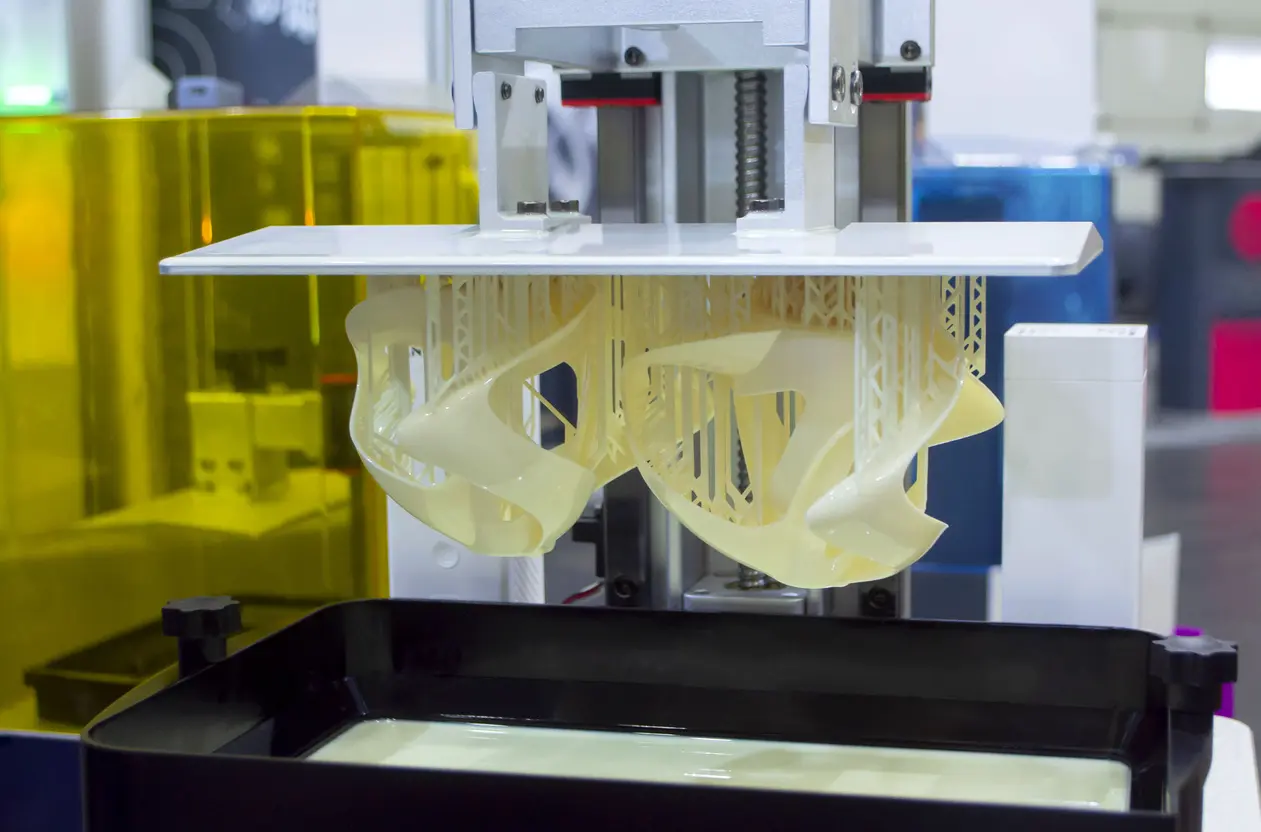
SLA is a 3D printing technique used to create stereolithography prototypes early in the product development process. Liquid resin is loaded into a vat on the stereolithography printer, and digital instructions from a CAD file are programmed in. A laser unit directs an ultraviolet beam to a reflective mirror where the laser traces a cross-section of the resin’s surface, solidifying the material and creating the first layer. The build platform moves up to allow the next layer to form. The support structure layers are drawn first, followed by the actual part layers. This continues until the full geometry is complete.
After printing, parts are washed in a solvent solution to remove uncured resin and placed in a UV oven for a final post-cure. Support structures are removed, and the part can be sanded, bead blasted, painted, or otherwise finished, depending on its intended use. The result is a solid plastic part with fine feature resolution and smooth surface finish.
Why Stereolithography Prototypes Are Used For Injection Molded Product Development
Stereolithography prototypes are used for injection-molded product development because the tooling is expensive and difficult to change once it has been cut. In addition to the cost, it can take weeks to have new tooling made. SLA prototypes provide a way to answer key questions in the early- and mid-stages of development, before tool design is finalized and changes are less expensive. At this point, design intent is defined, but details such as draft angles, wall thickness transitions, and feature interactions still need validation.
Stereolithography prototypes are commonly used by injection molders to:
- Verify part geometry before releasing the tool design
- Check fit and interaction with mating components and verify assembly
- Identify draft issues, undercuts, or wall transitions that may complicate molding
- Review cosmetic surfaces and visible features
- Support internal design reviews and customer approvals
- Modeling concepts before committing to tooling
- Evaluate user interaction and ergonomics
- Pre-production testing
These steps often uncover issues that are not obvious in CAD drawings alone.
When Stereolithography Prototypes Are Not the Right Choice
Stereolithography is well-suited for rapid prototyping components that require fine details, tight tolerances, or smooth surfaces. It performs best on geometries that are difficult or expensive to machine, such as those with thin walls, complex internal channels, and intricate surface features. But there are times when it is not appropriate.
Material mismatch: SLA resins do not match the full range of properties found in injection-molded thermoplastics, so strength, flexibility, heat resistance, and long-term durability may not translate directly to production parts.
Size limitations: The printer’s build volume can limit the size of the prototype. Larger components can often be split and joined to evaluate overall form and assembly, but seams and joints may affect fit checks and cosmetic review.
Mechanical property limitations: Stereolithography prototypes do not replicate the exact mechanical properties of injection-molded thermoplastics. Material behavior under load, heat, and long-term use will differ. This limits their use for full functional testing or validation of performance characteristics, such as impact resistance or creep.
Molding-process effects not captured: The process also does not reflect molding conditions. Flow behavior, gate location effects, weld lines, and sink are not represented in SLA parts. These factors must still be addressed during mold design and process development.
Understanding these limits helps teams use stereolithography prototypes appropriately. They are a tool for early validation, but not a substitute for molded samples.
Stereolithography Prototypes at No Cost With Rebate
Computer modeling is a useful first step, but many design questions are resolved faster when teams can handle and evaluate a physical part. Triad provides high-definition SLA 3D printing for concept validation of form, fit, and basic function before investing in injection mold tooling. Achievable accuracy is +/- .063 mm (+/- .002 in.), with typical part sizes up to 10in x 10in x 5in; larger components can be produced by splitting and joining parts for overall evaluation and assembly checks.
Triad also offers a rebate program that may reduce prototype cost to zero, depending on project details. If you are planning an injection-molded component and want to validate your design with SLA prototypes, contact Triad to discuss the rebate program and request a prototype quote.