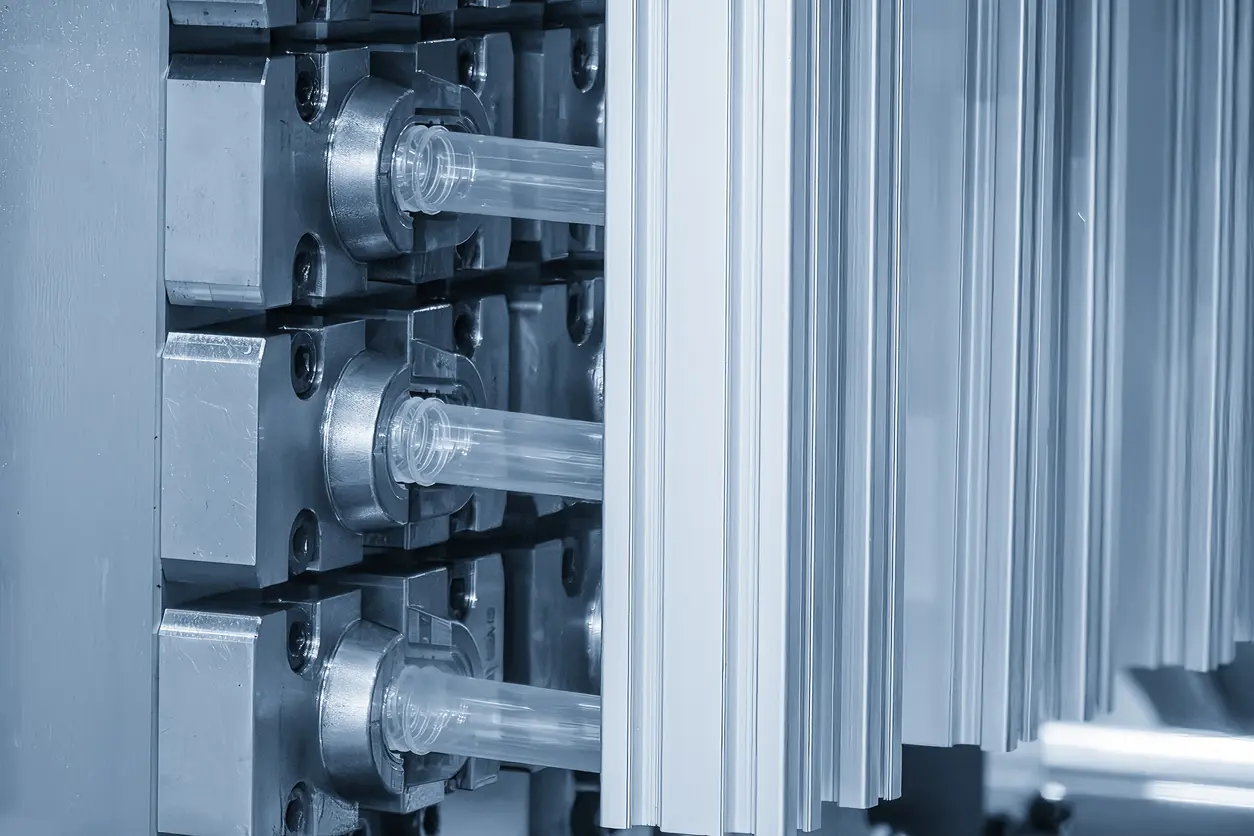
Medical OEMs rely on numerous forms of plastic fabrication services to obtain the components they need to deliver to their customers. Whether it’s an enclosure that’s placed in an emergency room or a vial cap that’s used in private practice, any medical component requires particular quality management systems behind production.
That’s why class 7 clean room plastic injection molding is so important for OEMs, supplier programs, and other customers of contract manufacturers. From creating a contaminant-free manufacturing space, to heightened quality control measures, class 7 clean room injection molding directly supports the medical industry.
Triad Plastic Technologies makes the case of why class 7 clean room plastic injection molding matters for medical-support applications by defining exactly what class 7 is, and other key topics to know before creating a partnership.
Defining What Class 7 Really Means
Class 7 clean room plastic injection molding refers to ISO 14644-1 certification and a manufacturer’s capability to create an environment where airborne particulate concentrations are limited. It’s critical to note that this doesn’t mean sterile components are being manufactured. Rather, it means an established environmental baseline has been created to control particle exposure during the manufacturing process, starting at molding and ending through packaging.
Cleanroom designation must be confirmed through particle count testing with the room designed, operated, and monitored constantly to maintain its designation.
Why it Matters in Injection Molding
Understanding what class 7 clean room plastic injection molding is matters. But understanding the why leads to a better grasp on what’s possible through clean room injection molding practices and how clean room molding impacts a manufacturing program.
When a manufacturer has earned a clean room status, it signals to customer bases that their components are protected at their cleanest point. Injection molded components are most vulnerable to harmful airborne agents when molding has finished and the component has ejected the mold, and before it’s placed in controlled packaging. When molding happens within a cleanroom, downstream washing is avoided.
Specific defects are limited when cleanroom molding takes place. Particles can damage cosmetic aspects, disturb sealing surfaces, contaminate optical or diagnostic areas, and complicate visual inspection in non-clean room programs.
Manufacturers with a clean room designation must adhere to stringent protocols to support the designation. This can include gowning, controlled entry, specific cleaning procedures, and clean compatible equipment. These are just examples of how manufacturers can reduce the chance for operators, material handling, packaging, or maintenance could introduce contaminants.
A class 7 clean room plastic injection molding operation supports consistent process conditions as well, which has a direct impact on manufacturing and part performance in real-world applications. There should be established documented procedures for cleaning, environmental monitoring, training, preventative maintenance, and material flow. This places control on supporting repeatable manufacturing. Additionally, cleaner packaging handoffs are achievable with a class 7 designation as the handoff occurs in a specific route.
Common Medical-Support Applications
| Application | Component Examples |
| Fluid management | Manifolds, connectors, valves, caps, ports, pump housings |
| Drug delivery systems | Syringe subcomponents, autoinjector/injector housings, inhaler parts, cartridge interfaces, disposable delivery device components |
| Diagnostics and lab settings | Test cartridges, sample-handling parts, analyzer housings, optical interfaces |
| Surgical and clinical equipment | Instrument handles, procedure trays, equipment housings, clamps, covers |
| Contamination sensitive parts | Any component where cleanliness impacts safety, device performance, and user confidence |
What OEMs and Other Prospective Contract Manufacturer Customers Should Clarify
The moniker ‘Class 7 Clean Room’ isn’t enough to confirm that a manufacturer is properly capable of clean room molding capabilities. OEMs, supplier programs, and other customer sources of contract manufacturers should vet capabilities against what’s claimed.
This starts with directly verifying current ISO 14644-1 certification and identifying the conditions of the molding room. From there, confirming all equipment necessary for a manufacturing program is within the confined space of the clean room.
Consider reviewing environmental monitoring plans, particle count testing results, cleaning schedules, and clean room procedures as well. In relation to the material, ask your potential contract manufacturer how the material is received, dried, transferred, and protected from contamination.
Asking your potential class 7 clean room plastic injection molding manufacturer any and all questions related to their operation should be encouraged by the manufacturer as they should also be upfront about capabilities.
Partner with Triad Plastic Technologies, a Class 7 Clean Room Plastic Injection Molding Manufacturer
Since 1988, Triad Plastic Technologies has provided OEMs with high-quality custom injection molded components. Our technologically driven manufacturing operations create components that reach every corner of the United States and in multiple industries – including the medical field.
That’s why our position as a Class 7 clean room plastic injection molding manufacturer matters greatly not just to us, but all of our customers too. Triad’s clean room molding techniques are perfect for products that require a contaminant-free manufacturing environment for use in the medical field or other sensitive applications. We provide up to Class 7 cleanliness, and from 138 tons to 385 tons of clamping pressure.
Simply put, medical OEMs know they can count on Triad’s clean room molding capabilities. And you can too. Contact our team today for more information on our clean room molding capabilities and how we can work together to create the components you and your customers need.