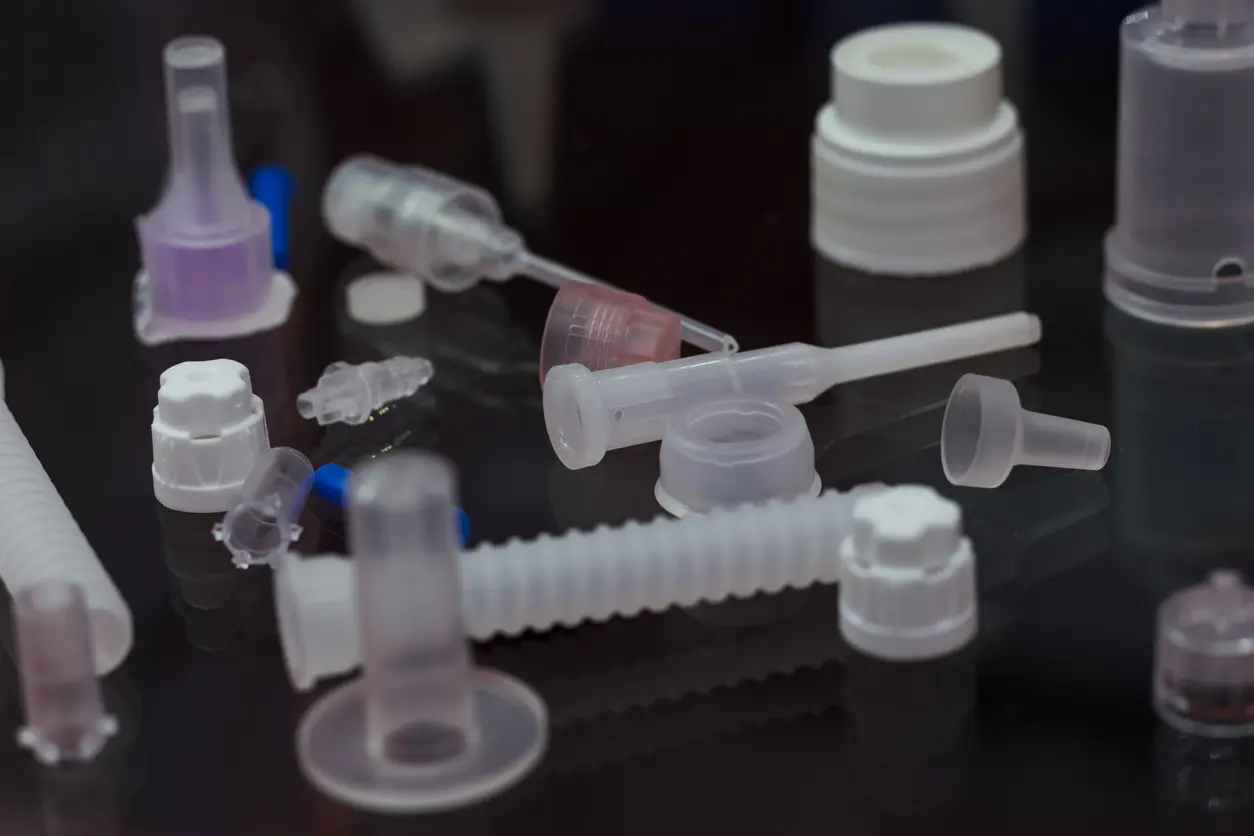
Medical plastic components appear in multiple applications throughout the medical field and medical OEMs rely on injection molding for many of these components. Whether it’s an enclosure that covers sensitive equipment or merely a vial cap, injection molding supports cost-effective, repeatable high-volume manufacturing.
Some of the biggest benefactors of medical plastic components are seen in general equipment, lab settings, and other healthcare-support applications such as patient treatment and diagnostic work.
Triad Plastic Technologies highlights how injection molding supports medical plastic components for those specific applications and why OEMs prefer injection molding compared to other plastic fabrication operations.
Common Applications of Medical Plastic Components
| Application | Components | Injection Molding’s Contribution |
| Medical Equipment | Instrument housings, display bezels, battery doors, sensor covers, knobs, buttons, pump components | Support for integrated snaps, bosses, ribs, and mounting features |
| Diagnostics | Test cassettes, cartridge bodies, reagent reservoirs, sample cups | Tight fluid path geometry, repeatable manufacturing for assembly features |
| Lab Products | Microplates, vial caps, specimen containers, tube racks | Multi-cavity production, chemically resistant components, dimensional consistency |
| Healthcare Support | Syringe and needle hubs, inhaler components, medication cups, sanitation dispensers | High-throughput production of repeatable and consistent geometries |
| Surgical & Clinical Tools | Handles, grips, clips, trays, device covers | Color coding capabilities and functional assembly features |
Injection Molding Manufacturing Advantages
Medical plastic components created through injection molding experience the unique benefits that stem from this manufacturing operation – and those benefits also extend to both contract manufacturers and OEMs.
When injection molding is used to create medical components, complex features are supported. This is because designs allow for living hinges, snap fits, threads, sealing grooves, ribs, bosses, windows, labeling areas, and alignment features. A secondary benefit to this inclusion of complex features in the design is that it largely reduces secondary operations which save on costs.
Arguably the largest benefit is that once tooling is locked in place, injection molding is one of the most scalable manufacturing operations in the world. This allows for the creation of high-volume program runs where consistency and repeatability are the driving force. And consistency is critical when components feature mating aspects, closures, seals, and automation.
Injection molding is also a cost-effective manufacturing style. The initial high costs of tooling offset through high volume production runs as the cost-per-part drops considerably.
Design Considerations
Design aspects of molded medical plastic components is where contract manufacturers and OEMs work together to create a part that’s both manufacturable and can work in real-world environments. This starts with designing for manufacturability, which entails uniform wall thickness, generous radii at corners, acceptable draft at ejection zones, and designing gates and parting lines away from vital functional surfaces.
In the design process, there needs to be consideration for part tolerance. The function of a component should determine the acceptable tolerance in a part and if there are assembly features tied to a component, that tolerance also needs reviewed to ensure tolerance stack-up is minimized.
Strong design processes utilize prototyping capabilities as well to confirm positive design features and identify weak points, then further enhance those points to ensure a part is functional. Prototyping takes place before any tooling occurs in order to save on costs of the expensive rework that would be associated with tooling if a design isn’t set.
The Importance of Quality and Medical Regulations
Any manufacturing program must be supported by strong quality management systems, but when it comes to medical plastic components, it goes beyond a manufacturer’s internal quality management systems.
While encouraging to see ISO certifications, United States’ manufacturers like Triad Plastic Technologies must adhere to new regulations that became effective in February 2026. The Food and Drug Administration rolled out new quality management regulations for the creation of finished medical devices. The main takeaway of these new regulations is its incorporation of ISO 13485, which is the industry standard QMS for the manufacturing of medical devices. While an injection molded component may not be a whole device, if it’s included in a final product, it must adhere to the standard.
This forces manufacturers to stay on top of their QMS and promote strong quality control throughout the entire manufacturing process. For contract manufacturers supplying OEMs with medical plastic components, this can include a thoroughly documented QMS of a manufacturing program, supplier qualification, process control and monitoring, mold maintenance and inspection, traceability, and clean room manufacturing that limits contamination.
Contact Triad Plastic Technologies for High-Quality Molded Medical Plastic Components
Triad Plastic Technologies, located in Reno, Nevada, is one of the country’s premier custom injection molding manufacturers. Since 1988, our commitment to investing in cutting-edge technology from both an engineering and manufacturing perspective has served as our main differentiator.
Through our Class 7 Clean Room certification, it’s much more easily feasible for our team to create injection molded medical plastic components. Our production process begins with design reviews and prototyping capabilities to ensure we’re creating the components you and your customers need. From there, we go straight into either transfer tooling or mold design and creation to finalize the DFM and prototyping process, and then injection molding begins.
Every one of our injection molding programs is backed by our quality management systems where we utilize process inspections, material traceability, part inspection and testing, and more.
Medical OEMs, when it comes time for the manufacturing of your medical plastic components, contact Triad Plastic Technologies for technologically driven solutions and 35-plus years of experience.