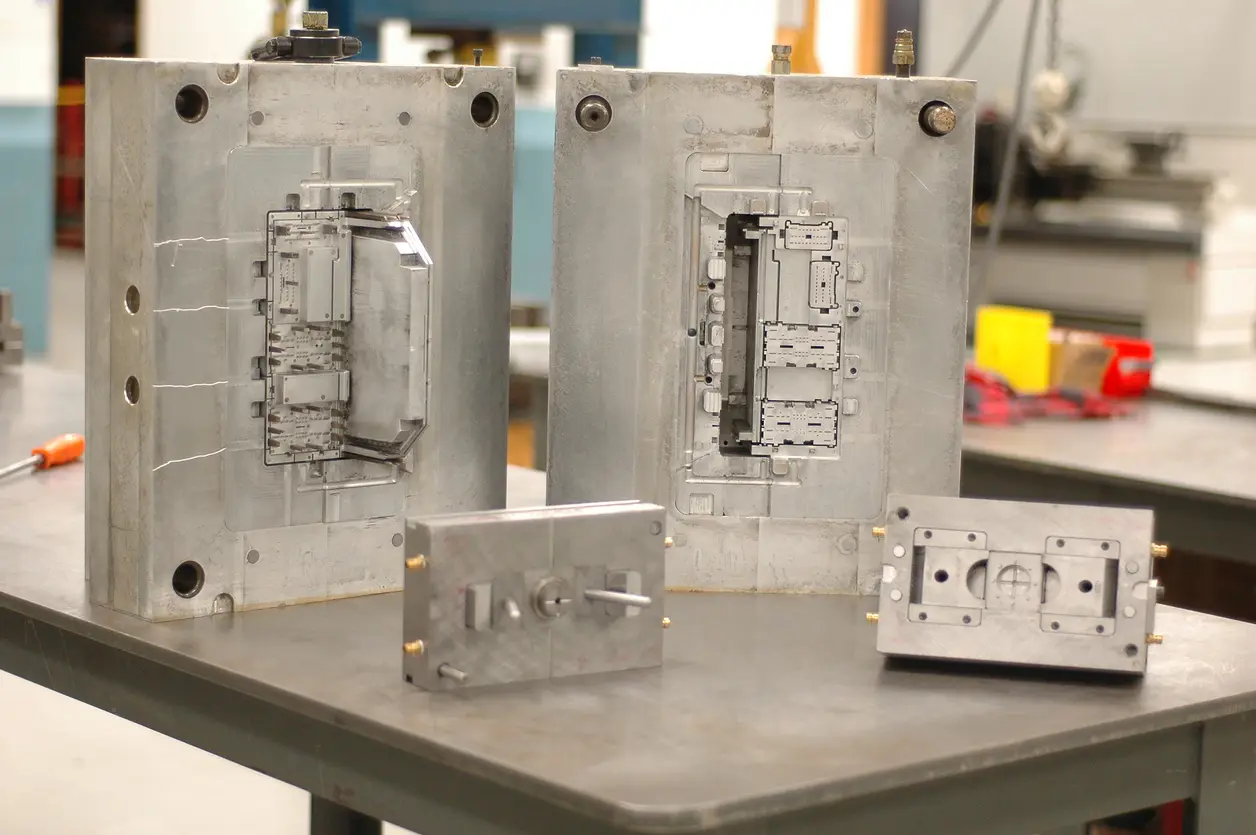
Plastic injection mold repair is the worst-case scenario in the world of mold maintenance. But it does happen, and when it does, it’s important for customers to know what these services entail, how long it takes for a mold to become operational, and if there’s a point where a new mold becomes necessary.
Mold repair situations are usually discovered during transfer tooling operations as a previous manufacturer might have disregarded proper maintenance, leaving customers to scramble to get their mold operational.
Triad Plastic Technologies details what all plastic injection mold repair services include and what to expect during this manufacturing downtime.
When Mold Repairs Become Necessary
Plastic injection mold repair services become a necessary operation because of a couple different events happening. The first being, molds weren’t properly maintained or maintained at all. The second being an accident that causes a mold to suffer a defect that’s beyond mere maintenance operations.
Even with proper maintenance, molds wear down over time and when routine maintenance schedules aren’t making the difference they used to, repair services can take over in some capacity to restore molds to operational health. Your team’s mold might need repair services if any of these are noticeable:
- Excessive wear on cavities and cores
- Damaged parting lines
- Ejector pin wear or failure
- Cooling channel restrictions
- Corrosion or rust
- Surface damage
- Broken inserts
- Inconsistent dimensions impacting part quality
Leaving these issues unresolved is going to create even larger problems, so if and when these occur, strongly consider mold repair operations.
Common Repair Operations
Identifying the causes for mold repair services is critical. But so is knowing the actual repair services manufacturers can perform. One of the go-to solutions for manufacturers is cavity and core restoration operations. When these aspects of the molds have considerable wear, it can impact dimensions, surface finish, and overall part quality.
Welding repairs are used when molds have cracks, chips, and other worn areas. Welding restores damaged sections without requiring mold replacement, which is a big cost saving advantage of mold repair services. Ejector systems where pins and other aspects also can be liable for mold repair operations. When any part of an ejector system is damaged, it can delay the ejection of the component from the mold which causes both mold and component defects.
Other repair operations can focus on vent and surface restoration. When vents are blocked and mold surfaces are damaged, cosmetic defects and molding inconsistencies can arise.
Partner with Triad Plastic Technologies for Your Plastic Injection Mold Repair Services
Triad Plastic Technologies has provided high-quality, technologically driven custom injection molding solutions to OEMs, supplier programs, and other customer bases for nearly 40 years.
Based out of Reno, Nevada, our team of technicians, designers, engineers, and executives work together to create the solutions our customers need for their customers. Part of those solutions include plastic injection mold repair. We begin with ultra-precise 3D scanning technology capable of capturing surface deviations down to a few microns. This allows us to accurately assess wear, cracks, or deformation, compare current geometry to original CAD models, and generate detailed digital twins for documentation and future reference. In addition to our 3D scanning, we utilize fiber laser welding to micro weld intricate mold features, repair fine edges, corners, and parting lines, and preserve base material integrity and hardness.
We perform our mold repair services on the promise of minimized manufacturing downtime, cost-effectiveness, high-fidelity restoration, and eco-friendly operational practices.
Experiencing issues with your current mold? Contact Triad Plastic Technologies today.